Earlier this year, we wrote about what was coming to Atlanta in 2026 and why local businesses should pay attention. At the time, many of the city’s biggest projects were still in the planning stages: ambitious ideas backed by big budgets and even bigger deadlines.
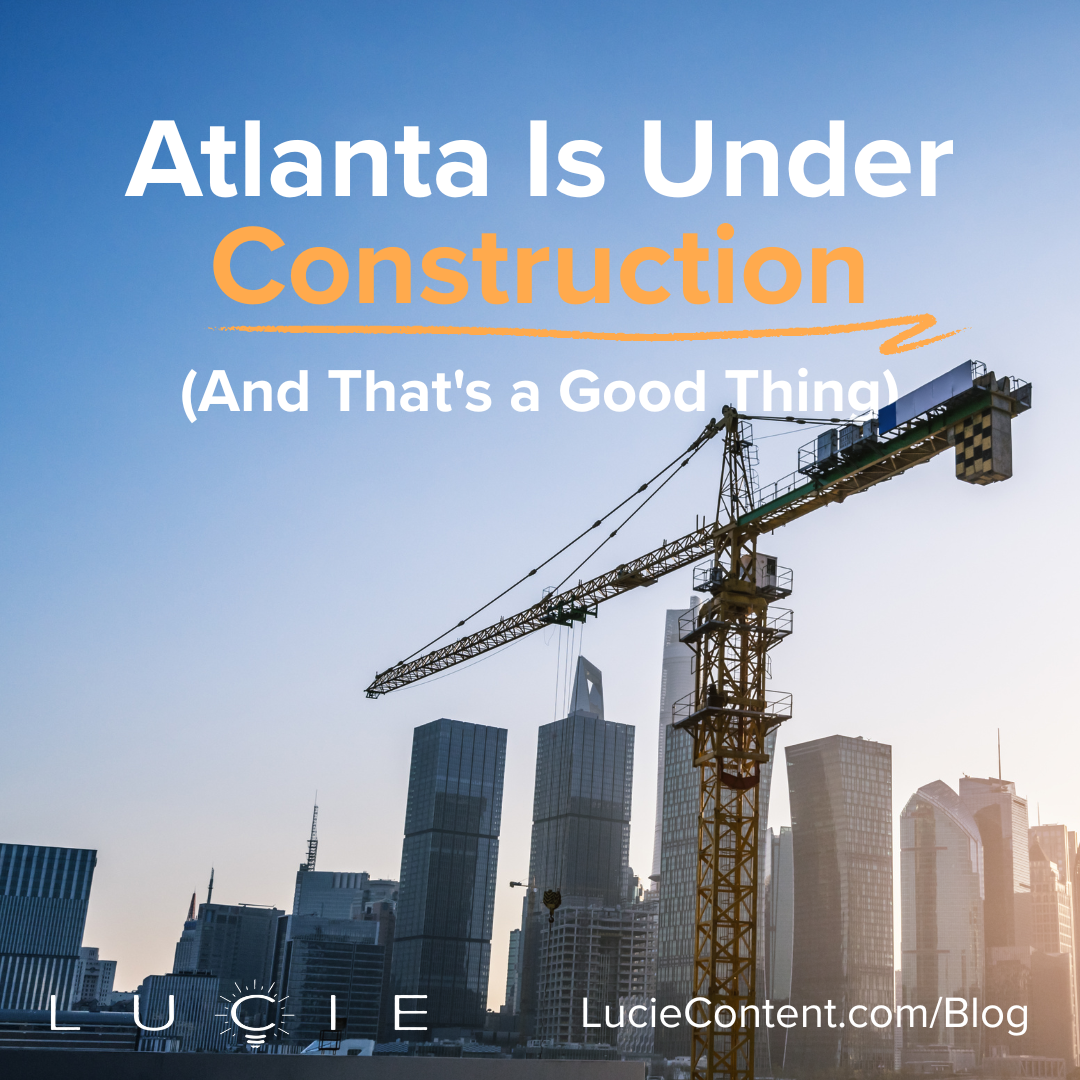
A few months later, the deadlines are a lot closer, and the construction cranes are very real. With Atlanta’s first major international soccer tournament match kicking off June 15 at Mercedes-Benz Stadium, the city has shifted from planning mode into full execution. Billions of dollars of infrastructure, transit, and urban development are actively underway across downtown, and a lot of it is intended to outlast the tournament by decades.
Here’s where things stand right now, and what it means for Atlanta businesses.
The Bigger Picture: Atlanta Is Trying to Fix a Real Problem
Let’s be honest about something first. Atlanta has a walkability problem.
The city’s overall Walk Score sits at 48 out of 100, officially “car-dependent.” While certain neighborhoods like Midtown, Old Fourth Ward, and the GSU area score in the 80s and 90s, most of metro Atlanta is built around the usage of cars. According to recent data, about 78% of Atlanta residents drive to work, and the city ranks among the worst in the country for traffic congestion, with drivers losing roughly 80 hours per year to gridlock.
For a city competing for talent, tourism, and long-term investment against places like Austin, Nashville, and Charlotte, that’s a meaningful disadvantage. Young professionals increasingly choose more walkable cities. International visitors, especially the 300,000-plus expected this summer, arrive expecting a navigable city, not one that requires a rental car and a parking strategy.
The good news is that Atlanta’s leadership seems to understand this, and the world’s biggest sporting event, coming to the city this summer, has given them the urgency (and the funding justification) to move faster than the city normally moves. What’s happening right now isn’t just preparation for a big soccer tournament, it’s an attempt to build the kind of city infrastructure that changes how people live here for the long term.
The Beltline: 85% Complete and Moving Fast
When we first covered this, the Beltline was around 30% complete after roughly two decades of development. With a $242 million budget approved specifically to accelerate construction before the tournament, trail completion is now projected to hit 85% by the end of fiscal year 2026, nearly three times further along than where it started.
Here’s what’s actively happening on the ground:
The Southside Trail Segments 2+3, 1.9 miles running west of I-75/85 to Boulevard, are finishing up concrete work now, with the trail targeted to be fully open before the tournament begins. The Northwest Trail hit a milestone in October 2025 when officials cut the ribbon on Segment 5 through Blandtown, pushing the total completed mainline trail to nearly 14 miles. A pedestrian bridge over Northside Drive broke ground in January 2026 as part of connecting the Northwest corridor toward West Midtown and, eventually, the Buckhead area. And a new 8-acre Enota Park on the Westside Trail, featuring a splash pad, basketball courts, a solar-shade pavilion, and a boardwalk through tree canopy, is on track to open before June.
The Beltline’s impact on businesses near the trail has been well-documented. It creates foot traffic where there previously wasn’t any, connects neighborhoods that were effectively isolated from each other, and turns businesses along the corridor into community gathering spots rather than destination-only stops. For Atlanta businesses located near Beltline access points, that’s not a theoretical benefit. It’s a real change in who walks past your door.
MARTA’s Biggest Upgrade in 25 Years
If the Beltline is about getting people to walk more, MARTA’s 2026 overhaul is about making it realistic for more people to leave their cars behind altogether. The improvements coming this spring and summer represent the most significant transformation of Atlanta’s transit system since 2000.
The most visible change: the new CQ400 railcars, built by Swiss manufacturer Stadler, are currently being tested on Atlanta rail lines. Four train sets are undergoing testing right now, with the first trains entering revenue service in early June, just before the tournament begins. The cars feature open gangways you can walk through freely, colored “smile” lights on the front that indicate which rail line is approaching, built-in charging stations, real-time service info, and extensive camera and safety technology. MARTA says 65% of current delays are tied to the aging fleet, some of which dates to 1979, so this is a reliability upgrade as much as it is an aesthetic one.
Beyond the new trains, several other changes are rolling out simultaneously:
The Better Breeze contactless payment system is being installed systemwide right now, allowing riders to tap a bank card or mobile wallet at fare gates, the same experience you’d have on transit in New York, London, or Tokyo. The customer transition period runs from late March through early May, with both systems running simultaneously.
The MARTA Rapid A-Line, the region’s first Bus Rapid Transit line, is targeting a spring/summer launch. It will connect downtown Atlanta to Summerhill, Peoplestown, and the Beltline’s Southside Trail in dedicated bus lanes with off-board payment, cutting travel times in a corridor that currently has limited transit options.
The NextGen Bus Network launches April 18, delivering 15-minute service frequency to three times as many metro Atlanta residents. And MARTA Reach, the agency’s new on-demand van service offering first-and-last-mile connections, launched March 7 across 12 defined zones throughout the city.
Five Points Station, the downtown hub that international visitors will pass through constantly, is getting new ceilings, lighting, and flooring as part of a $1 billion systemwide rehabilitation program, all timed to complete before June.
None of this happens to serve just the tournament. More reliable transit means more employees can reach more employers. More accessible neighborhoods means more customers for more businesses. A contactless payment system means that a first-time visitor or a new resident doesn’t need to figure out a special transit card just to get around.
Downtown Is Being Rebuilt, Block by Block
If you haven’t been downtown recently, the pace of change is genuinely striking.
Centennial Yards, the $5 billion development transforming the former Gulch between Mercedes-Benz Stadium and State Farm Arena, is racing toward its tournament-season debut. Hotel Phoenix (18 stories, 292 rooms) is already open. The Mitchell, a 304-apartment residential tower next door, is open as well. Within the 8-acre Entertainment District, a 14-story boutique hotel topped out in January. The centerpiece, Cosm Atlanta, a 70,000-square-foot immersive entertainment venue with an 87-foot dome, has announced it opens June 10, the day before the first match of the world’s biggest soccer tournament is played in North America. A Live Nation music venue is under construction alongside it. Tenants already signed include Busy Bee Café, Shake Shack, and The Irish Exit.
The broader goal for Centennial Yards, as stated by Atlanta Mayor Andre Dickens, is to give people a reason to be downtown beyond attending a specific event. A year-round entertainment district that draws people on a Tuesday, not just a game day, changes the economics of the surrounding neighborhood for every business in it.
South Downtown, the 10-block stretch of renovated historic buildings between Five Points and Garnett MARTA, is pursuing a parallel strategy. The district is restoring 57 historic buildings across 16 acres, activating street-level retail, and creating a pedestrian environment that connects MARTA riders to the stadium. Ten new restaurants are expected to open by June. Developers are even offering short-term “summer leases” to brands looking to test a downtown location this summer, an interesting entry point for businesses that want to reach the global soccer audience without a long-term commitment.
Georgia State University’s campus transformation is adding something downtown has lacked for a long time: daily foot traffic from a captive residential population. The $107 million “College Town Downtown” project, funded largely by an $80 million gift from the Robert W. Woodruff Foundation, the largest in the university’s history, is in active construction. Sparks Hall, GSU’s original campus building, came down in November 2025 to make way for the Panther Quad: a grassy amphitheater, elevated plaza, and greenway connecting Hurt Park to the campus. Gilmer Street is already closed to vehicles between Peachtree Center Avenue and Courtland Street. The university is also taking a more active role in managing Woodruff Park, which sits at the center of the campus and downtown alike.
The logic here: more students living downtown means more consistent foot traffic for downtown businesses, day in and day out, long after any sporting event is over.
Underground Atlanta is being revitalized with pedestrian-only blocks on Upper Alabama Street and a planned micro food hall in a restored Antebellum-era building near Five Points. The stated goal isn’t just to impress visiting fans. It’s to create the kind of walkable, neighborhood-scaled streetscape that attracts residents and keeps them coming back.
What This Means for Your Business
You don’t have to be located in the immediate vicinity of Mercedes-Benz Stadium to benefit from what’s happening in Atlanta right now. The thread running through all of these projects is the same: more people moving through more parts of the city, more often, in more ways.
A more complete Beltline means businesses near the trail can market their accessibility in ways that weren’t true two years ago. Better MARTA service means customers who previously couldn’t reliably reach your location now can. A revitalized downtown, with new residents, students, and visitors, means a broader customer base for the businesses that serve them.
The immediate opportunity is obvious: if you haven’t yet created content that speaks to Atlanta’s transformation, this summer is the window. Video content that tells your Atlanta story, showcases your location, or connects your brand to the energy of the city will land differently right now than it would in a quiet year. The audience is attentive, and Atlanta is genuinely in the global spotlight.
But the longer-term opportunity may be more valuable. The infrastructure being built this year, the transit, the trails, the urban density, is the foundation of a more livable, more connected Atlanta. The businesses that understand that shift and position themselves accordingly now will be the ones best placed to benefit as it matures.
Atlanta has always had ambition. Right now, it’s backing that ambition with concrete.
Ready to create content that captures Atlanta’s momentum? Let’s talk.